Showing posts with label Education around the world. Show all posts
Showing posts with label Education around the world. Show all posts
Tuesday, December 22, 2015


Sunday, December 20, 2015
Saturday, September 12, 2015
Wednesday, September 2, 2015
Hawaiian dance
I have founded really interesting video of dances from Hawaii.
It is so unusual and amazing
It is so unusual and amazing
Tuesday, August 18, 2015
Цікава стаття про викладання англійської мови
пропоную ознайомитися з прекрасною статтею (особливо коментарі) щодо збільшення годин для викладання англійської мови.
http://osvita.ua/school/47604/

Friday, September 12, 2014
Thursday, March 6, 2014
Wednesday, November 6, 2013
Проблеми Російської освіти такі самі, як і в нас
Круглый стол. Образование в глобальной сети.
У нас в студии Елена Тихомирова - председатель Ассоциации e-learning специалистов, Светлана Павлова - генеральный директор интернет-проекта «Дистанционный репетитор», Михаил Кушнир - советник "Лиги образования, Александр Прутченков - профессор кафедры экономики МИОО, по скайпу из Санкт-Петербурга Анатолий Шперх - эксперт Школьной лиги РОСНАНО, учитель информатики, из Экспоцентра – Иван Засурский, журналист, преподаватель. Ведет программу Тамара Ляленкова.
http://www.svoboda.org/media/video/25141832.html

Tuesday, October 15, 2013
Saturday, October 5, 2013
ideas for the primary school
download the presentation >>>>>>>>>>
Особливості навчання читання учнів молодшого шкільного віку
Київ, Київська обл., Черкаси | 2013-09-11

Роб Дін неодноразово відвідував Україну та проводив семінари та тренінги з учителями англійської мови, які завжди були успішними та цікавими.
Цього разу свою презентацію, а скоріше це можна було назвати інтерактивний тренінг, Роб присвятив навчанню англійської мови в 1 класі. Невелика актова зала спеціалізованої середньої школи № 130 Києва вмістила майже 100 вчителів не тільки зі столиці, але й інших міст та містечок України.
Тренінг був настільки інтерактивним та захоплюючим, що дві години сплинули непомітно.
Вчителі з радістю та ентузіазмом зможуть застосувати практичні та цікаві ідеї на уроках у своїх школах. Багато з цих ідей та видів діяльності були взяті з сучасного підручника Tracks. І вони без сумніву допоможуть вчителям молодших класів ефективно розвивати мовні навички своїх учнів, зокрема уміння читати, слухати та вчити слова, а учням брати активну участь у навчальному процесі та полюбити англійську мову.
Кожний учасник семінару отримав сертифікат участі та інформаційний пакет. У кінці семінару були розіграні подарунки - звичайно ж, книжки та підручники, якими користувався Роб при підготовці семінару.
Роб провів три семінари в Україні - в Києві, в Софіївсько-Борщагівському НВК 1-3 ступенів (Києво-Святошинський район, Київська область) для вчителів Київської області та місті Черкасах - для вчителів міста та області.
У розділі Матеріали для вчителів Ви можете завантажити цікаві ідеї для роботи в класі, які запропонував Роб Дін на семінарі.
Details >>>>>>>
Особливості навчання читання учнів молодшого шкільного віку
Київ, Київська обл., Черкаси | 2013-09-11
Роб Дін неодноразово відвідував Україну та проводив семінари та тренінги з учителями англійської мови, які завжди були успішними та цікавими.
Цього разу свою презентацію, а скоріше це можна було назвати інтерактивний тренінг, Роб присвятив навчанню англійської мови в 1 класі. Невелика актова зала спеціалізованої середньої школи № 130 Києва вмістила майже 100 вчителів не тільки зі столиці, але й інших міст та містечок України.
Тренінг був настільки інтерактивним та захоплюючим, що дві години сплинули непомітно.
Вчителі з радістю та ентузіазмом зможуть застосувати практичні та цікаві ідеї на уроках у своїх школах. Багато з цих ідей та видів діяльності були взяті з сучасного підручника Tracks. І вони без сумніву допоможуть вчителям молодших класів ефективно розвивати мовні навички своїх учнів, зокрема уміння читати, слухати та вчити слова, а учням брати активну участь у навчальному процесі та полюбити англійську мову.
Кожний учасник семінару отримав сертифікат участі та інформаційний пакет. У кінці семінару були розіграні подарунки - звичайно ж, книжки та підручники, якими користувався Роб при підготовці семінару.
Роб провів три семінари в Україні - в Києві, в Софіївсько-Борщагівському НВК 1-3 ступенів (Києво-Святошинський район, Київська область) для вчителів Київської області та місті Черкасах - для вчителів міста та області.
У розділі Матеріали для вчителів Ви можете завантажити цікаві ідеї для роботи в класі, які запропонував Роб Дін на семінарі.
Details >>>>>>>
Thursday, January 17, 2013
Blended Learning Approach
Уважаемые коллеги!
По просьбе Олега Борисовича Тарнопольского высылаю адрес,
по которому можно заказать его книгу “Constructivist Blended Learning Approach
to Teaching English for Specific Purposes”. Сайт: http://versita.com/cblaeng Кликнув на Read, Вы попадете на
страницу De Gruyters, где размещена электронная версия монографии. Монография
пока в открытом доступе и ее можно посмотреть.
С уважением, С.Л.
Бобырь.

Friday, September 21, 2012
Friday, September 7, 2012
Genki helps with discipline

7
Sep
 We’ve had plenty of Discipline ideas before if you have several (or a whole class!) of misbehaving kids.
And today’s discipline technique is for when you are lucky (or unlucky!) enough to have just one difficult student.
And it is very simple:
Make them your executive assistant for the day!He/She comes to the front and helps you out, doing demo discussions, helping explain things etc.
Very often if there is just one problem student in the class it’s because they aren’t being challenged enough.
So making them your assistant can do wonders.
Have you tried this before? Do let us know how you got on in the comments.
Or check out the previous Discipline ideas
Be genki,
Richard
Press the "+1" button if you like this!
Similar Posts:
- Discipline: The bad kids at the back!
- Discipline 2: Fred Jones
- Discipline & Power Teaching
- New Summer Clothes!
- New “I’d like some food” Software Updates!
- Think you’ve got discipline problems?
- Help Please: What do you do? Software Update!
10
May

Wow, yesterday’s post on the “bad kids at the back” and the proximity trick certainly proved popular.
Judging by the feedback and comments I think there is one more discipline technique we need: The Agreement.
It uses the Pygmalion Effect which refers to the phenomenon in which the greater the expectation placed upon people, often children or students and employees, the better they perform.
But first let me tell you a story from my own school days ….
My class at school was pretty well behaved really.If you can sympathise with that story, The Agreement is what you need.
But one day we had a new temp French teacher.
We could just tell she didn’t have confidence.
So what did some kids do?
They pushed the boundaries to see what they could get away with.
What did she do? Nothing!
So they pushed some more and more and more.
Each time they could see they were getting at her and it just became a game to see how far they could go.
Eventually she broke down in tears and ran away. (Yep, seriously!)
It was really like seeing a bunch of wild wolves tearing away at her!
It’s not all you need, but you do need it.
This one is tough for one off lessons, but if you see the kids more than once it will be revolutionary.
So here we go … Bikers & Police
Whenever humans interact there is always a, usually tacit, unspoken, agreement as to how we should behave.
For example I bet you’d behave differently to a uniformed police officer to how you would behave with a young baby.
And you’d behave differently when seeing a dodgy looking biker dude on the street compared with your best friend from college.
It’s just part of who we are.
We assess the situation, think back to how we should behave and change how we act accordingly.
Sleeping & Learning
For all its faults the school system has done a pretty good job of setting up this behaviour and expectations.
The teacher stands at the front.
The students sit quietly in rows sleeping, sorry, learning.
The problems come when this breaks down.
Either from a lack or parents, a lack or parenting or even teachers in lower grades.
They leave some kids just not knowing what is expected of them.
They have no frame of reference or experience to work from.
Or even worse they pick up the bad expectations of their peers.
How far can they go? Just what is allowed in class? What can they get away with?
Even the best classes can succumb to this as we saw above.
Luckily this also means that even the worst classes can be turned around!

And how do we do this?
By simply setting out, before we start, the expectations of the class.
The agreement between you and them, to see what each side expects of each other.
For example the teacher will set out that they will:
Teach really cool useful stuff (either for life or for exams) in a really fun way.Next you set out what you expect from the kids
Respect the kids and listen to what they have to say.
E.g. They will:
Act respectfully of each other and the teacher.For younger kids keep it really simple.
Always try their hardest, no matter what.
Speak up and keep trying.
And of course for older kids it’s always best to ask them to come up with their own ideas.
You’ll get the smart kids saying “We agree to sleep and do nothing.”
So have a discussion about it! Ask them if that’s really want they want to spend their time on.
Usually though, it won’t go this far.
Most kids just want to know what to do and what is expected.
That’s all they ask for.
And if it’s not there they will always act up.
We all want, and need, boundaries so we know what behaviour to go with.
Yes they’ll still push you and push the limits, that’s what kids do.
But just stand firm and stick to the agreement.
And you’ll need some punishments to back you up.
Once everyone knows where they stand and it will solve, not all, but a great deal of the problems.
It sounds crazy doesn’t it?
But just like the proximity trick it’s just these simple steps that separate the great teachers from the chaotic ones!
What I do …
Even now I always do this with every presentation I do.
And those of you who keep a sharp eye on the blog will have noticed than whenever I forget then that’s when things go pear shaped!
You can even make your students smarter by expecting them to be!
I expect all of you to listen to what I say, but not believe it till you’ve tried it.
And I hope you always expect me to always try my best to help you reduce the stress levels whilst coming up with fun ideas to make your classes better.
That’s the way we roll here.
Keep the agreement and we all win!
Be genki,
Richard
P.S. A few people have asked how you do this if you don’t speak the kids’ language, as obviously it won’t work in English. I’d always just get another teacher to do it for you. Or get it written up on the board. That can be just as effective. But remember, don’t do this in all classes. Just the ones you want to be well behaved!
Press the "+1" button if you like this!
Similar Posts:
- Discipline: The bad kids at the back!
- Discipline 2: Fred Jones
- Discipline: Zig Ziglar
- Prizes & Addiction: Give them or not?
- You’re not charging enough…
- Start your own school Tip 1: Where to hold class?
- Discipline & Power Teaching
One of the most popular questions in the surveys is always about discipline and how to keep kids under control.
And contrary to what people often think, a fun class is usually the most disciplined. (Otherwise it would just descend into chaos!)
Luckily there are a few simple “ninja tactics” to make even the toughest class at least a little easier to handle.
So let’s start with the first (and my favourite) : Proximity!
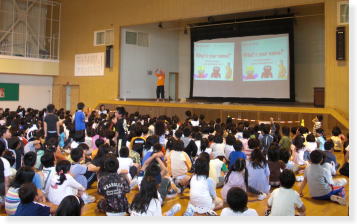
(A Genki English demo class with 600 kids – easy with these tricks!)
Let’s imagine a traditional classroom set up.
The teacher is at the front with the computer.
The good kids sit down in the first row.
(They are rarely a problem so that’s cool.)
But where do the “bad” kids sit?
Yep, that’s right…
…on the back row!
But the question is…..
Why?
.
Are the comfiest seats there?
Do they have free gummy bears on tap?
Nope, it’s simply because that’s the furthest they can possibly be from the teacher.
Kids instinctively know that the further away from the teacher they are, the more they can get away with!
So what’s the solution?
Simple, just move nearer to them!
And that’s the basis for the proximity technique.
It sounds just too simple doesn’t it?
And that’s why most teachers don’t use it.
They resort to shouting at the kids.
Sometimes even throwing things.
All whilst stood firmly at the front of the class!
Now think about the best teachers you know.
Where do they stand?
Are they always at the front?
No, very often they’re always moving around.
They slowly move up and down the rows as they talk.
They sometimes explain something at the back of the class.
Then explain the next at the front.
The kids never know where they’ll go next so they’re always on best behaviour.
Just like mixing a fruity birthday cake, you’ve got to keep the motion going so nothing turns sticky and stale!
Sometimes a kid will get a little out of line.
So what does the good teacher do?
They simply move closer and stand by the kids’ desk.
There’s no eye contact, no harsh words, everything just continues as before.
The teacher never misses their story, they just keep going on like before.
When the student has calmed down they simply walk away to somewhere else in the room.
They never need to resort to any negative punishments.
It’s all done with proximity – how close they physically are to the students.
(One other beauty of this is that the “bad” kids often clump together so you can get several of them in one go!)
So the next time you find the kids at the back are too chatty or not paying attention,
Just slowly start moving around the class, gradually stopping by their desks as you talk.
In the vast majority of classes it will make all the difference.
And of course, as with all Genki English techniques, only use it on the classes you want to make better!
If you like this please feel free to share, link to, like it or make a comment.
If it’s popular enough I’ll see if I can share my other top discipline tips with you!
Be genki,
Richard
P.S. If you are reading this on email, if you have a look at the online version there are more discipline tips and videos at the end of this post!
And contrary to what people often think, a fun class is usually the most disciplined. (Otherwise it would just descend into chaos!)
Luckily there are a few simple “ninja tactics” to make even the toughest class at least a little easier to handle.
So let’s start with the first (and my favourite) : Proximity!
(A Genki English demo class with 600 kids – easy with these tricks!)
Let’s imagine a traditional classroom set up.
The teacher is at the front with the computer.
The good kids sit down in the first row.
(They are rarely a problem so that’s cool.)
But where do the “bad” kids sit?
Yep, that’s right…
…on the back row!
But the question is…..
Why?
.
Are the comfiest seats there?
Do they have free gummy bears on tap?
Nope, it’s simply because that’s the furthest they can possibly be from the teacher.
Kids instinctively know that the further away from the teacher they are, the more they can get away with!
So what’s the solution?
Simple, just move nearer to them!
And that’s the basis for the proximity technique.
It sounds just too simple doesn’t it?
And that’s why most teachers don’t use it.
They resort to shouting at the kids.
Sometimes even throwing things.
All whilst stood firmly at the front of the class!
Now think about the best teachers you know.
Where do they stand?
Are they always at the front?
No, very often they’re always moving around.
They slowly move up and down the rows as they talk.
They sometimes explain something at the back of the class.
Then explain the next at the front.
The kids never know where they’ll go next so they’re always on best behaviour.
Just like mixing a fruity birthday cake, you’ve got to keep the motion going so nothing turns sticky and stale!
Sometimes a kid will get a little out of line.
So what does the good teacher do?
They simply move closer and stand by the kids’ desk.
There’s no eye contact, no harsh words, everything just continues as before.
The teacher never misses their story, they just keep going on like before.
When the student has calmed down they simply walk away to somewhere else in the room.
They never need to resort to any negative punishments.
It’s all done with proximity – how close they physically are to the students.
(One other beauty of this is that the “bad” kids often clump together so you can get several of them in one go!)
So the next time you find the kids at the back are too chatty or not paying attention,
Just slowly start moving around the class, gradually stopping by their desks as you talk.
In the vast majority of classes it will make all the difference.
And of course, as with all Genki English techniques, only use it on the classes you want to make better!
If you like this please feel free to share, link to, like it or make a comment.
If it’s popular enough I’ll see if I can share my other top discipline tips with you!
Be genki,
Richard
P.S. If you are reading this on email, if you have a look at the online version there are more discipline tips and videos at the end of this post!
Press the "+1" button if you like this!
Similar Posts:
- Discipline 2: Fred Jones
- Discipline: The helper!
- Discipline: The Agreement!
- Discipline & Power Teaching
- 10 Top Tips for Starting Your Own School
- How to teach abcs
- Help, My Junior High Kids Are Dead!
How would you like a class full of little angels who are all your perfect students?
A lot of the time we talk about actual practical techniques here, but this is something different.
This is how I get great students, for everything, it’s a really simple technique, but it really works.
What do you think?
Be sure to put your comments below. (Also be sure to put what you have to become in the comments too!)
P.S. The winner of October’s comment competition was Dan! If you’d like to win a Genki English CD of your choice this month, get commenting below, the more you comment you more chance you have to win!
A lot of the time we talk about actual practical techniques here, but this is something different.
This is how I get great students, for everything, it’s a really simple technique, but it really works.
What do you think?
Be sure to put your comments below. (Also be sure to put what you have to become in the comments too!)
P.S. The winner of October’s comment competition was Dan! If you’d like to win a Genki English CD of your choice this month, get commenting below, the more you comment you more chance you have to win!
Press the "+1" button if you like this!
Similar Posts:
- Win a free CD … you next?
- Competition Winner
- And the winner is …
- New Workbook Pics for Teaching Food
- MP3s for your students (& printable workbooks!)
- The winners are…
- And the winner is ….
One thing I’m trying to get teachers to do more is to make the
initial vocab introduction a bit more fun. ”Repeat after me” with a
list of vocab is really boring!
But doing a story or getting the kids’ opinions can make all the difference in making them lean forward and be interested or leaning back and tuning out!
Robots
Simple examples can be asking the kids “What do you think my favourite subject is?” for subjects. If they shout out one that is in the song, you teach it there and then. Then tell them you have another favourite subject and ask them to guess what that is. Keep going till all the vocab is taught. The kids stay fixated to the end, especially when there is only one more to guess!
Or for the Eat, Drink, Dance theme, you can make up stories like ….
It makes it a lot more fun when there’s a “why” to the learning. Another great idea for the Eat, Drink, Dance theme, which the teachers came up with on Saturday, my birthday, was to say “Oooo, it’s Richard’s birthday today! We’re all going to his party tonight! What will we do at the party?” and you then introduce the vocab when they kids shout it out and proceed with the lesson plan.
Cops & Robbers
You can also use it for a lot of the songs. e.g. asking a superhero “Where are you going?” in the Where are you going? lesson. Or in the “What are you doing?” song get the kids to pretend to be cops and robbers who get annoyed with them. It’s hilarious and really livens up the chorus of a song – check out the video!
But doing a story or getting the kids’ opinions can make all the difference in making them lean forward and be interested or leaning back and tuning out!
Robots
Simple examples can be asking the kids “What do you think my favourite subject is?” for subjects. If they shout out one that is in the song, you teach it there and then. Then tell them you have another favourite subject and ask them to guess what that is. Keep going till all the vocab is taught. The kids stay fixated to the end, especially when there is only one more to guess!
Or for the Eat, Drink, Dance theme, you can make up stories like ….
Oooo look, I’ve just bought a new robot (one of the students). What do you think we can make him do? (Kids shout out stuff). Ahhh.. but he only understands English instructions! Ask the kids again what instructions they’d like to give & teach the ones that come up from the song. Just say “ah, I don’t think he can do that!” for the others. Again the kids love it when there’s only one more command left and they have to guess it!Cakes
It makes it a lot more fun when there’s a “why” to the learning. Another great idea for the Eat, Drink, Dance theme, which the teachers came up with on Saturday, my birthday, was to say “Oooo, it’s Richard’s birthday today! We’re all going to his party tonight! What will we do at the party?” and you then introduce the vocab when they kids shout it out and proceed with the lesson plan.
Cops & Robbers
You can also use it for a lot of the songs. e.g. asking a superhero “Where are you going?” in the Where are you going? lesson. Or in the “What are you doing?” song get the kids to pretend to be cops and robbers who get annoyed with them. It’s hilarious and really livens up the chorus of a song – check out the video!
Press the "+1" button if you like this!
Similar Posts:
- What’s your favourite …? in video
- Eat! Drink! Dance!
- Broom Catch
- Do you like animals?
- Help Please! Which New Stationery (pens, books etc,) Song?
- New And …. But…. Song
- Lesson of the Week: Easter Egg Hunt
(There are lots of videos in today’s post, so if you are on email then click here to see them!)
Today we had a workshop in Shinjuku Tokyo right outside the Ministry of Defence!
One of the requests for was for some card games using the Mini Cards. Now to be honest I don’t really like card games as although they are really fun, the kids tend to spend more time sorting out the cards than speaking English. But if you really have to use them….
* First do the Do you have any pets? song to get the English in their heads (or whatever theme you are teaching that day)
* Then you could try the Do you have.. ? Card Game
But as you can see from the video below, you really have to have really good control over the class as otherwise it just turns into chaos!
Shut it down!
I also have no hesitation in shutting a game down right away if the kids stop listening – even the teachers below were a bit surprised!
It is important as otherwise no English gets practiced.
If you forget a rule…
Part way through I noticed I’d forgotten an important rule “Only English during the game” (of course it’s important to use the kids’ native language when explaining the game, but not during the game!)
The clap technique that I show in the Beginner’s Workshop Video doesn’t work when they have cards in their hands, so I had to teach them another class control technique!
Normally you would do only one game for one lesson, but seeing as the teachers wanted to see some more games we just re-used the same English with Island Hopping
And then the minicards version of the Leapfrog Game:
So as you can see I’m not a big fan of card games in class! I much prefer “no preparation” games like the ones I wrote up in the Genki English Manual as the kids spend way more time actually speaking.
But what do you think? Answers in the comments please!
Today we had a workshop in Shinjuku Tokyo right outside the Ministry of Defence!
One of the requests for was for some card games using the Mini Cards. Now to be honest I don’t really like card games as although they are really fun, the kids tend to spend more time sorting out the cards than speaking English. But if you really have to use them….
* First do the Do you have any pets? song to get the English in their heads (or whatever theme you are teaching that day)
* Then you could try the Do you have.. ? Card Game
But as you can see from the video below, you really have to have really good control over the class as otherwise it just turns into chaos!
Shut it down!
I also have no hesitation in shutting a game down right away if the kids stop listening – even the teachers below were a bit surprised!
It is important as otherwise no English gets practiced.
If you forget a rule…
Part way through I noticed I’d forgotten an important rule “Only English during the game” (of course it’s important to use the kids’ native language when explaining the game, but not during the game!)
The clap technique that I show in the Beginner’s Workshop Video doesn’t work when they have cards in their hands, so I had to teach them another class control technique!
Normally you would do only one game for one lesson, but seeing as the teachers wanted to see some more games we just re-used the same English with Island Hopping
And then the minicards version of the Leapfrog Game:
So as you can see I’m not a big fan of card games in class! I much prefer “no preparation” games like the ones I wrote up in the Genki English Manual as the kids spend way more time actually speaking.
But what do you think? Answers in the comments please!
Press the "+1" button if you like this!
Similar Posts:
- What does work in super big groups?
- Weather & Countries Card Game
- New Game: I want to be a ghost!
- Christmas “What’s missing?” card games
- Discipline 2: Fred Jones
- CD9 Games in Action
- Who can…? Game
Monday, September 3, 2012
Quiet Signals
Quiet Signals and Timers

One of the keys to good cooperative learning is good classroom management. If you feel this is a weak area for you, don't worry. As a part of your cooperative learning explorations, you can learn many management strategies that will help you all day long. The most important strategy of all is a good quiet signal. Perhaps "quiet signal" isn't the best term because you are not trying to make them get quiet and remain quiet. What I'm referring to is a signal to get your students' attention so you can give them additional directions. The best quiet signals are quick, easy, and effective. Your quiet signal has to be something that you can use over and over all day long, and something to which you will train your students to respond immediately. Try out a few different ones, and then choose one that you can stick with.
You can also use timers as quiet signals when your students are involved in activities that can be broken down into timed segments. You'll find some suggestions at the bottom of this page.
Qualities of a Good Quiet Signal
- Students can SEE it from anywhere in the room.
- Students can HEAR it when they are interacting in teams.
- It's not overly annoying when used 15 times in one day!
- Room should be quiet within 3 to 5 seconds. If it takes longer, it's not working.
Favorite Quiet Signals
| Chimes - Tapping a tune
on a set of chimes (pictured on the right). There's something soothing
about the sound of chimes, and yet it commands attention! Hand Up and Count -Teacher holds up one hand and slowly counts to 3. Students look at teacher, hold up one hand, and put finger to lips to signal others. Room must be quiet by the count of 3. Clapping Patterns - Teacher claps 2 times slowly. Students respond by clapping 3 times quickly (which means they have to stop working and put things down that they are holding.) Rain Stick - Teacher holds up rain stick and shakes it. Students hold up one hand to signal others. Room must be quiet by the time the stones in the rain stick fall to the bottom. |
Other Quiet Signals:
- Tap on wind chimes or xylophone. Students raise hand to signal others to get quiet.
- Wind up music box at the beginning of the week. Open lid and lets it play until room is quiet. By doing this repeatedly throughout the week, the music box winds down. If there is any music left at the end of the week, students earn 15 minutes free time.
- Hold up a giant Mickey Mouse hand. Students raise hand to signal others.
- Ring a bell 3 times. Students look at teacher for instructions.
Teaching Your Quiet Signal
Most people don't realize that it's important to actively teach your students your quiet signal. Telling isn't teaching! As soon as you put them in teams, tell them that since you are going to allow them to talk during cooperative activities, you need to be able to get their attention immediately. Explain your quiet signal and tell them that you are going to time them the first few times. Let them know that you expect them to be quiet and ready for instructions within 3 to 5 seconds. Have them put their heads together and talk over something like what their favorite food is. After a few moments, use the quiet signal and start watching the clock from the moment you give it. Wait until the room is absolutely quiet and then record the amount of time it took. If it was more than 5 seconds, tell them that they will have to do better. Give them another discussion topic and try again. Usually they will do much better the next time. Keep working on it until they have mastered it.
 Using Timers as Quiet Signals
Using a timer can be an effective quiet signal because it allows
students to see how much time is left before they need to stop working
and give you their attention. For example, instead of asking your
students to work on a science activity for an unspecified amount of
time, you can say, "Class, you have 5 minutes to brainstorm ideas for
your wind-powered car." Then record the starting and stopping times on
the board and use the classroom clock to time the activity. Or you can
use one of the fun options below that make use of new technologies.- Online Timers - If you have an interactive white board in your classroom, or even a desktop computer, online timers make great quiet signals. You can program in the timer to count up or count down, depending on the task you want to time. One of my favorite free websites is Online Stopwatch at www.online-stopwatch.com. They have some amazing and extremely creative timers on their website, but after you explore them, you may want to use the basic timer for most everyday tasks. The bomb and rocket timers are fun to use with games, but can also be potentially distracting to students who are working.
- Smartphone Timers - Many teachers have told me that they use the built-in timer on their Smartphone as a count down or count up timer. The obvious problem with using this strategy is that you have to have your phone on and you may receive calls or text messages during instructional time which is a no-no in most schools.
 Time Tracker
- For many years, I used a Time Tracker like the one shown here to
track time and alert students when we needed to switch to another
activity. The Time Tracker starts out with the green area lit up, then
switches to a yellow warning light, and finally the red area lights up
when the time runs out. You can program different amounts of time for
each section, and you can even program it to say "Time's Up!" at the
end. It worked really well for guided reading and math groups. It's a
little tricky to learn to program, but after you figure out how to enter
each time, you'll love it. Just don't throw away the directions!
Time Tracker
- For many years, I used a Time Tracker like the one shown here to
track time and alert students when we needed to switch to another
activity. The Time Tracker starts out with the green area lit up, then
switches to a yellow warning light, and finally the red area lights up
when the time runs out. You can program different amounts of time for
each section, and you can even program it to say "Time's Up!" at the
end. It worked really well for guided reading and math groups. It's a
little tricky to learn to program, but after you figure out how to enter
each time, you'll love it. Just don't throw away the directions!
Frequently Asked Questions
- Do I have to use a Quiet Signal? I have never used one
before. I just wait for my students to get quiet. Eventually they all
get quiet and I give my directions.
A quiet signal is critical to keep from wasting time and to keep the momentum going during cooperative activities. Suppose that you need to give a quiet signal 5 times each hour and it takes 1 minute to get your class quiet each time. That's 5 minutes of wasted time each hour, or 30 minutes of wasted time each day. If you multiply that by 180 school days, you end up wasting 90 hours of time (or 15 whole days!) just with waiting for the class to get quiet!
- What should I do if I teach middle school (or high school
or college)? I just don't think older kids will respond to a quiet
signal. They will feel that it's babyish.
You might have to get a bit creative to find just the right quiet signal, but it will work for older kids too. Of course you wouldn't expect them to put their fingers to their lips like first graders! I've seen middle school teachers get very silly with their quiet signal (a huge Mickey Mouse hand), and the kids just thought it was cool! I know of one high school chemistry teacher who discovered that glass beakers make a nice ringing sound. He set up a few in different sizes and tapped on them in a special way. Another middle school teacher introduced me to the idea of the using a rain stick and shaking it. Find something that makes a little noise, and make it work for you! You could also explain to your students why you need a signal and let them help you devise one. Your other option is to use some of the cool online countdown timers described above.
Wednesday, August 29, 2012
Friday, February 17, 2012
Teaching speaking video
Шановні колеги,
запрошую вас переглянути серію відео-сюжетів, що стосуються навчанню усного мовлення.
Усі вісім серій ви можете переглянути тут >>>>>>>>>
запрошую вас переглянути серію відео-сюжетів, що стосуються навчанню усного мовлення.
Усі вісім серій ви можете переглянути тут >>>>>>>>>
Friday, January 27, 2012
Webinar 5.2 Towards a Pedagogy of Peace

Time: February 1, 2012 from 8am to 9:30am
Location: Online
Event Type: webinar
Organized By: Moderator Jenny
Location: Online
Event Type: webinar
Organized By: Moderator Jenny
Presenter: Marti Anderson
Abstract: This webinar will allow us to look at the pedagogies of
peace and to unearth and examine some of the inherent violences of
education, educational systems, and teaching practices. The main goal is
to share ideas about how teaching and education have the responsibility
and potential to uplift and uphold core human values and growth.
Learning English should be an uplifting and empowering experience! We
will explore this together.Presenter Bio:
Marti Anderson is a teacher training and education consultant living in Thailand. She has trained and provided professional development for teachers on 6 continents in dozens of countries. Marti views teaching as one of the most important professions because of the life-long impacts that education and educational processes have on people. Marti's interests and experience explore the inner dynamics of teachers and how they use their intentions and beliefs about teaching to shape their work in order to have the best possible outcomes for their learners.
Subscribe to:
Posts (Atom)